
What AI in Manufacturing Can and Cannot Do for Plant and Warehouse Operations Today

.svg)
The Distance Between the Demo and the Shift
A vendor demo shows a dashboard that predicts a machine failure three days out, reroutes production, and rebalances the crew before anyone notices a problem. The same week, a real plant loses two hours of output because a forklift battery died and nobody had flagged the spare as charged. That gap, between the polished demo and the messy shift, is where most plant and warehouse leaders actually live. The conversation about AI in manufacturing tends to skip right past it.
The technology has gotten good at specific, bounded jobs. It reads images, finds patterns in sensor data, forecasts demand, and turns a production schedule into a staffing plan faster than a person with a spreadsheet ever could. What it has not done is replace the operator who knows that Line 3 runs hot on humid days, or the supervisor who can feel a shift going sideways before the numbers say so. Both things are true at once, and pretending otherwise leads to budgets spent on tools that sit unused.
This piece sorts the real from the oversold. Some of what gets pitched as autonomous intelligence is genuinely useful today and already running in plants and distribution centers. Some of it is a slide that will not survive contact with a Tuesday night shift. Knowing which is which saves money, time, and the credibility you need to get the next project funded.
Why the Hype Keeps Outrunning the Plant Floor
Most coverage of AI in manufacturing leans on the headline cases, the fully automated dark factory in a press release or the pilot that cut scrap by a third on a single line under ideal conditions. Those stories travel well because they are clean. The plant floor is not clean. It has aging equipment from four different decades, data trapped in systems that were never meant to talk to each other, and a workforce that turns over faster than any model can be retrained.
The pattern repeats across the sector. A tool performs beautifully in a controlled pilot, then stalls when it meets the variability of real production. Demand spikes, a key material arrives late, three people call out on the same morning, and the model that assumed steady inputs starts handing out advice nobody can use. None of this means the technology is fake. It means the gap between a working algorithm and a working operation is wider than the marketing suggests.
The companies getting real value tend to be quieter about it. They picked a narrow problem, measured a baseline, and let the tool prove itself against that one number before expanding anywhere else. That discipline is less exciting than a moonshot, and it is also the reason their projects are still running a year later instead of gathering dust in a folder of abandoned initiatives.
What AI Does Well in Plants and Warehouses Right Now
The strongest applications share a trait. They take a repetitive, data-rich decision that humans make under time pressure and do it faster, more consistently, or at a scale a person cannot match. None of them run the plant. All of them hand a better answer to the person who does. Four areas have moved past the pilot stage and into daily use across food production, distribution, and discrete manufacturing.
Forecasting Demand and Turning It Into a Labor Plan
Forecasting is where machine learning has earned its place fastest. Given a few years of order history, seasonality, and known events, a model produces a demand projection that beats a planner working from last year's numbers and gut feel. The useful part comes next. That forecast can be converted into a shift-by-shift labor requirement, so a plant knows it needs eleven people on the packaging line Thursday and seven on Friday, not a flat crew sized for an average that never actually occurs.
This matters because labor is the largest controllable cost in most plants and warehouses, and overtime is where budgets quietly bleed. A model that maps demand to headcount lets planners build a schedule that tracks real volume instead of a static standard. When the forecast shifts, the staffing plan shifts with it. Work that used to eat most of a planner's day collapses into minutes, and the plan reflects what is actually coming rather than what happened last quarter. The model does not decide who works. It gives the planner a sharper starting point and far less guesswork.
Coordinating Headcount Against Live Production
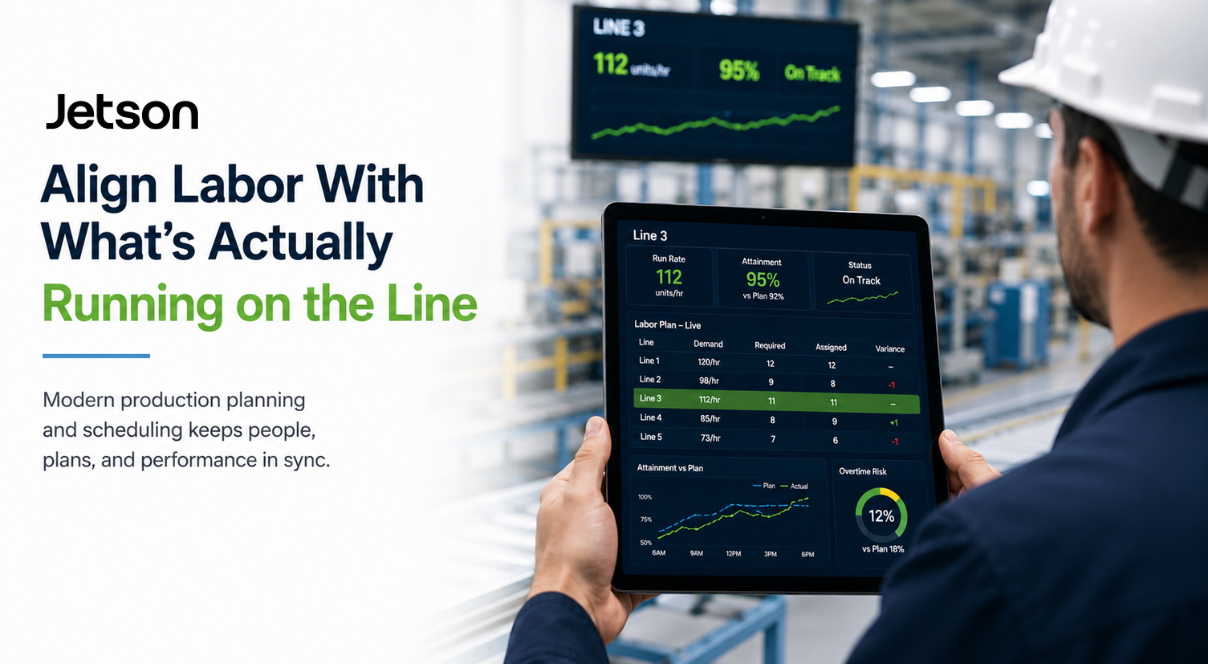
Once a shift starts, the plan and reality drift apart within the hour. A line goes down, a temp does not show, a rush order jumps the queue. This is where systems that coordinate labor against live production do their best work, and it is the problem an AI-powered operating platform like Jetson was built to handle. The software reads what is running, who is on-site and qualified, and where the gaps are, then recommends where to move people before idle time piles up.
The value sits in the speed of the adjustment. A supervisor managing this by radio and memory can cover one fire at a time. A system watching the whole floor can flag the second and third problem while the first is still being solved, and it can weigh qualifications and overtime cost in the same recommendation. The decision still belongs to the supervisor. The tool just makes sure that supervisor is looking at the right gap at the right moment, with the cost of each move already on the screen.
Catching Quality Defects With Computer Vision
A camera trained on a filling line can catch a crooked label or a short fill faster than a person watching a belt move at production speed. Computer vision is one of the most mature applications on the floor, and for good reason. Defect detection is a pattern-matching job, the kind of task where a model that has seen thousands of examples holds its attention better than a human eight hours into a shift.
These systems work best on high-volume, repetitive inspection where the defect is visible and the standard is consistent. Mislabeled packaging, surface scratches, missing components, fill levels, seal integrity, all of these are within reach today. What the camera does not do is judge a borderline case the way a seasoned quality lead would, weighing whether a cosmetic flaw on a particular customer's order actually matters. It flags the candidates and the person makes the call on the gray area. Used that way, vision systems cut the number of bad units that reach a customer and free up inspectors to focus on the judgment calls that still need a human eye.
Flagging Anomalies in Equipment and Process Data
A motor that starts drawing slightly more current, a bearing that vibrates a hair outside its normal range, a fill weight that drifts a few grams over an hour. Anomaly detection catches these small deviations in sensor and process data before they grow into a stoppage or a batch of scrap. The model learns what normal looks like for a given machine and raises a flag when readings wander off that baseline.
This is real and useful, with one honest caveat the hype usually drops. A flag is not a diagnosis. The system tells you something changed, not always what to do about it, and it will raise alerts that turn out to be nothing. The plants that get value here pair the alerts with a person who knows the equipment and can decide which warnings warrant a look. Treated as an early warning that sharpens a maintenance team's attention, anomaly detection pays off. Treated as a crystal ball that ends the need for that team, it disappoints. The difference is entirely in how the output gets used.
What AI Still Cannot Do on Its Own
The honest list of limits is shorter than the hype but more important to understand, because this is where money gets wasted. The pattern in every case is the same. The technology is strong at the bounded, data-rich slice of a problem and weak at the messy, contextual, human-judgment part that surrounds it. Buyers who assume the tool covers the whole job, not just the slice, are the ones who end up with shelfware. Four limits come up again and again.
Replace the Judgment of Experienced Operators
No model on the market replaces the operator who has run a line for fifteen years. That person carries thousands of unwritten rules about how the equipment behaves, which a model can approximate only where the data captures it, and most of that knowledge was never written down. The supervisor who senses a shift going wrong is reading cues, a sound, a smell, a slowdown that has not hit the metrics yet, that no sensor is recording.
The better tools are built to work with that knowledge rather than around it. The strongest labor platforms, for instance, learn from the judgment calls of a plant's most experienced operators rather than trying to overwrite them. That is the realistic relationship. The model handles the volume and the speed, the consistent recall, the watching of fifty variables at once. The person handles the exceptions, the context, and the calls that depend on knowing this plant and these people. Anyone selling a tool that promises to make that hard-won experience unnecessary is selling a slide, not a system that survives a real shift.
Run a Lights-Out Operation End to End
The fully autonomous, lights-out factory that runs untouched through the night is real in a handful of narrow, highly controlled settings and a fantasy almost everywhere else. The plants that approach it make one product, or a tight family of products, on purpose-built equipment with tightly controlled inputs. Most operations are nothing like that. They run mixed product, change over several times a day, and depend on materials that arrive late often enough to break any fully scripted plan.
Automation handles the repeatable physical tasks well, palletizing, moving product, packaging. The trouble is the long tail of small exceptions that humans absorb without thinking, a jammed case, a mislabeled pallet, a changeover that does not seat right. Each one is minor. Together they are why someone needs to be there. Aiming for full autonomy across a whole varied operation usually means spending heavily to automate the easy ninety percent while the last ten percent still requires the staff you were trying to remove. The math rarely works outside the narrow cases where it already does.
Overcome Bad Data and Disconnected Systems
No model fixes bad data, and most plants have plenty of it. Run rates in the ERP that have not been touched in three years, time clock entries that do not reconcile, crewing standards that describe a process the floor abandoned long ago. A model fed those numbers produces confident output that is quietly wrong, which is more dangerous than no output at all because people trust it.
The systems problem is just as common. The forecast lives in one tool, the schedule in another, actual hours in a third, and none of them share a number cleanly. A lot of what gets sold as intelligence is really integration, the unglamorous work of getting the ERP, the time clocks, the shop floor systems, and the HR system to agree on what happened. That work has to come first. The plants that skip it and buy the smart layer on top end up with a fast engine running on bad fuel. Cleaning the data and connecting the systems is the part nobody demos, and it is the part that decides whether anything built on top actually works.
Predict Every Breakdown Before It Happens
Predictive maintenance is one of the most oversold phrases on the floor. Models do catch some failures early by spotting the slow drift that precedes a breakdown, and that is worth real money on critical equipment. What they cannot do is catch every failure, and they will cry wolf often enough that teams learn to tune out the alerts if the tuning is wrong.
Sudden failures leave no gradual signature to detect. A part that snaps without warning gives the model nothing to see in advance. The honest version of predictive maintenance covers a subset of failure modes on a subset of machines where the economics justify the sensors and the modeling, and it runs alongside the scheduled and reactive maintenance that still has to exist. Sold that way, it earns its keep. Sold as the end of unplanned downtime, it sets up a disappointment that taints the next sensible project. The technology is genuine. The promise wrapped around it is usually two sizes too big.
Where the Return on AI Actually Shows Up
The return on AI in manufacturing rarely comes from the dramatic use case in the brochure. It comes from labor and throughput, the two numbers that move the most and that better decisions can actually shift. Labor is the largest controllable cost in most plants and warehouses, and the daily calls about how many people to staff and where to move them get made under time pressure with incomplete information. Sharpen those calls a few percent and the savings compound across every shift, every week, every site.
Overtime is the clearest example. Most overtime is not earned by genuine demand. It accumulates from coverage gaps that got patched late, from a plan that did not match the volume, from nobody seeing the cheaper option in the moment. A system that aligns staffing to real production and surfaces the lower-cost move trims that waste without touching output. One food manufacturer working with Jetson, profiled in the Stella and Chewy's case study, centralized its labor data and cut the time its team spent planning while gaining far clearer visibility into staffing needs. Those are the unglamorous wins that add up, and they keep showing up on the cost line quarter after quarter.
What a Real Use Case Needs Before You Sign
A genuine use case has a number attached to it before you buy anything. If a vendor cannot tell you which metric will move, by roughly how much, and how you will measure it against today's baseline, the project is a science experiment on your budget. The strongest projects start with a problem the operation already feels, an overtime line that keeps climbing, a quality escape that keeps recurring, and a clear before-and-after you can check inside ninety days.
Ask where the data comes from and whether it is clean enough to trust, because that question separates the serious tools from the demos. Ask what the model does when its inputs are missing or wrong, since that is Tuesday night, not a corner case. Ask to speak to a customer running it in production at your scale, not a logo on a slide, and read the detailed customer stories a vendor is willing to publish. A tool worth buying solves a bounded problem, connects to the systems you already run, and hands the decision to your people rather than pretending it can make the call alone. Anything that promises to run the operation should raise your guard, not your hopes.
Starting With One Shift Instead of the Whole Factory
Pick one shift, one line, or one site and prove the value there before you scale anything. The teams that succeed treat the first deployment as a measured test, not a transformation. They baseline the metric they care about, run the tool against it for a few weeks, and let the result decide whether it spreads. That approach costs less, fails cheaper when it fails, and builds the internal credibility you need to fund the next step.
Narrow scope also surfaces the integration and data problems early, while they are still small and fixable. A pilot on one line exposes the dirty run rates and the disconnected systems before they get baked into a company-wide rollout. The plants that go this route tend to ask sharper questions and buy less shelfware. Jetson's resource library covers how plant and warehouse teams structure these early deployments, and the common thread is patience. Start where the pain is sharpest and the data is cleanest, prove the number moved, then expand to the next shift. The factory-wide vision can wait until the single-shift result is real.
Putting AI to Work Where It Earns Its Keep
The version of AI in manufacturing worth your budget is narrower and more useful than the one in the headlines. It forecasts, it inspects, it watches for drift, and it coordinates labor against live production, while leaving the judgment to the people who run the floor. Jetson builds for that reality, helping plant and warehouse teams hit plan at the lowest cost. Start with one measurable problem, prove the number moved, and let the results decide what comes next.
.jpg)