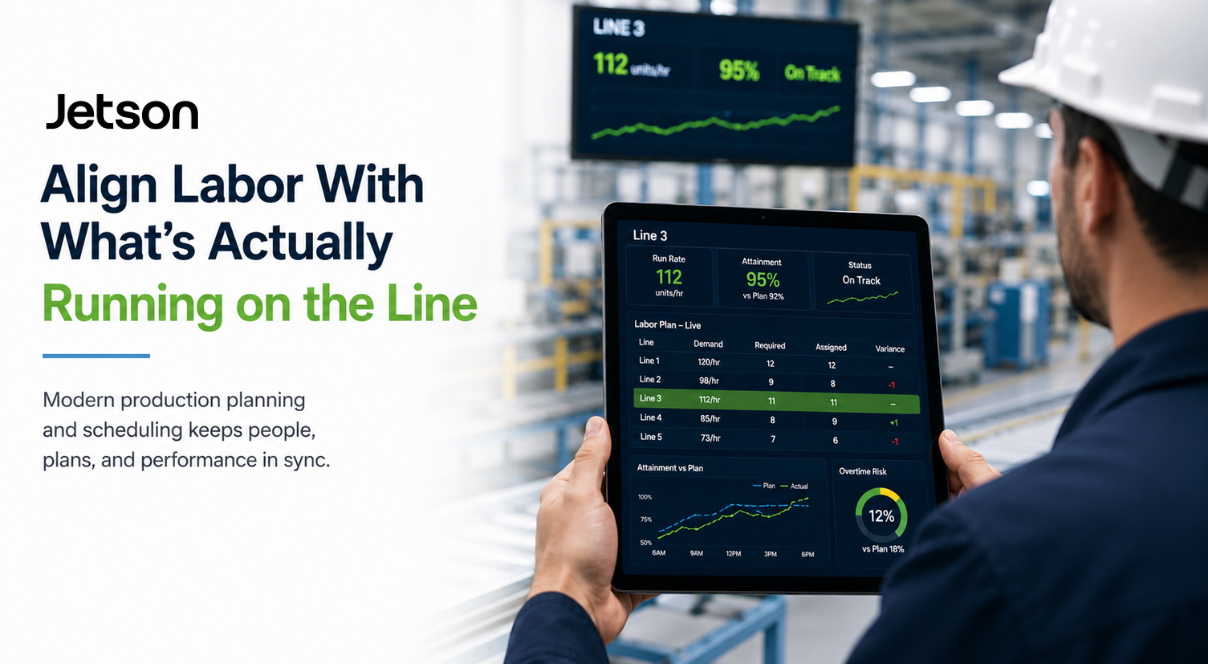
Why Stale Engineered Labor Standards Inflate Manufacturing Costs
.jpg)

.svg)
Here's a question most operations and finance leaders never think to ask: are your labor standards actually right?
Not just recent, but right. Plenty of companies have updated their standards in the past year or two and are still operating on numbers that don't reflect reality. Because the issue isn't just when you last set them. It's whether they're accurate to how your operation actually runs today.
If there's any doubt, there's a good chance you're leaving real money on the table. Not because of bad management or poor strategy, but because the benchmarks driving your production and capacity planning software inputs are quietly out of step with reality.
The Hidden Impact of Late Visability on Manufacturing Cost Reduction
Engineered labor standards (the expected throughput or time required to complete a run) are the backbone of capacity planning. They inform how you run your headcount planning, how you allocate resources, and how you measure floor capacity. When they're accurate, everything runs efficiently. When they're not, the inefficiencies are subtle but expensive, causing massive operational variance without your knowledge.
Late visability often lead to overstaffing and structural variance. If your ERP standards say a run takes 12 minutes but your team has optimized it down to 9 (thanks to better tooling or process improvements), you may be over-scheduling capacity and taking a direct hit to your production cost and margin control every single shift.
The reverse is also true. If standards are too aggressive, you might be chronically under-capacitated, driving up unexpected variance, throwing off your overtime tracking and management, and bottlenecking total plant output.
Either way, the delta between your standards and live floor actuals leads to bad budget vs actual reporting and a direct hit to your bottom line.
Why Fixed ERP Production Assumptions Go Stale and Cause Floor Variance
Static standards don't expire with a warning label. They drift, throwing off your plan vs actual and operational variance reporting. Here are the most common culprits:
- Technology and automation changes. New packaging lines or machinery can dramatically change productivity and throughput, but static ERP rates rarely get updated to reflect this. You end up planning based on old assumptions about a process that no longer exists.
- Skill level evolution. Your active floor skills today may be significantly different than when your static crewing standards were set. Experienced line operators achieve different throughput speeds than new teams, and old standards don't reflect live capabilities.
- Process improvements. If your plant has adopted lean principles or optimized material flow, your baseline metrics may be anchored to an older, slower version of your operation, skewing your variance analysis report models.
- Volume and product mix shifts. Changes in order volume, SKU complexity, or product mix can all change real-world productivity and throughput, but they're rarely updated inside static legacy tracking systems.
- How they were built in the first place. Freshly set metrics can cause immediate variance if they were based on observed runs during a non-representative period, without being cross-referenced using accurate manufacturing intelligence software.
What Variance Looks Like in Practice Across Factory Floors
Consider a facility utilizing food manufacturing software that set its line crewing standards three years ago, before investing in new packaging automation. The new machinery runs significantly faster, but the ERP production assumptions were never updated. As a result, they suffer from structural variance, over-allocating headcount each shift by 10-15% and losing hundreds of thousands of dollars in unnecessary spend.
Or think about a facility using standard warehouse labor management parameters that updated its metrics during a low-volume period. Now that throughput requirements have ramped up, those assumptions are broken. Finance leaders see that their budget vs actual reporting looks completely wrong because scheduling is anchored to inaccurate capacity models.
These aren't edge cases. They're the norm at plants that lack the real-time downtime tracking and analytics infrastructure required to catch operational variance.
The Fix: Make Standards a Living Asset
The good news is that this is a solvable problem, and the ROI on solving it is typically fast. A few places to start:
- Audit standards against actual performance data. Where are the biggest gaps? Are certain teams or shifts consistently over- or under-performing against standard? That delta is your opportunity.
- Ask whether your standards were validated when they were set. If they were based on observed work samples, how representative were those samples? Were they collected during a peak period, a slow season, or a stretch when your most experienced people happened to be on shift?
- Establish a regular review cadence. Labor standards shouldn't be a one-time project. They should be revisited whenever there's a meaningful change to process, technology, volume, or workforce composition, at minimum annually and more frequently in high-change environments.
- Involve the people closest to the work. Frontline managers and team leads often know exactly where the standards are off. Bringing them into the process builds accuracy and buy-in at the same time.
How Jetson Automates Variance Reporting and Labor Forecasting
This is exactly the problem Jetson was built to solve. We partner with operations and finance teams to validate and maintain precise crewing requirements based on live productivity and throughput metrics, ensuring your planning tools match true capacity.
Whether you're configuring a new line or executing deep production cost and margin control on existing setups, we close the gap between your legacy ERP assumptions and actual floor performance.
The Financial Impact: Minimizing Budget and Capacity Variance
Outdated operational benchmarks are a primary driver of unseen margin erosion. They don't appear as an explicit line item on your ledger, but they manifest as unnecessary overhead, thrown-off job costing software for manufacturing calculations, and over-inflated shift spend.
If you are relying on static spreadsheets to evaluate your capacity targets, your data is hiding severe variance. Upgrading to a continuous plan vs actual and operational variance reporting framework is the only way to safeguard your baseline corporate profitability.
Tracking Plan vs Actual Variances and Overhead Inflation
When finance teams look at manufacturing expenditures, they typically focus strictly on direct wages paid to line operators. However, stale production assumptions quietly distort indirect costs as well, introducing major waste into your operational model. Miscalculated benchmarks force plant managers to waste time resolving planning variances and fixing spreadsheet calculation errors manually.
This administrative overhead prevents operations leaders from focusing on bottleneck removal and true efficiency gains. Furthermore, when your baseline assumptions remain misaligned with real-world capacity, your budget vs actual reporting becomes fundamentally broken. The secondary financial damage ripples directly into your monthly variance statements and product margins.
By allowing unverified assumptions to dictate your daily scheduling, your business absorbs hidden expenses that drain capital. Correcting these underlying calculations through a secure erp integration layer is a core component of sustainable manufacturing cost reduction, stabilizing operational cash flow and protecting facility margins.
Implementing Sustainable Manufacturing Cost Reduction Strategies Safely
When corporate margins tighten, many executives rely on arbitrary budget cuts to lower operational expenses. Simply forcing a blunt headcount freeze across a facility is a high-risk move that damages operational consistency, triggers severe delivery delays, and spikes line disruptions. Effective strategies for long-term fiscal health rely entirely on increasing underlying productivity and throughput rather than overextending an under-resourced floor.
To execute successful manufacturing cost reduction strategies, enterprise leaders must identify measurable ways to remove non-value-added bottlenecks from the shift schedule. Introducing a real-time variance report framework helps management identify exactly which processing lines are falling short due to equipment bottlenecks or raw material placement issues.
Giving frontline supervisors accurate capacity targets ensures that daily line assignments remain perfectly achievable. This data-driven approach builds a stable operational environment where baseline manufacturing profits expand alongside climbing schedule attainment scores.
Technical Process Improvements: Maximizing Throughput and Eliminating Bottlenecks
Updating baseline operational expectations requires a continuous commitment to real-time data integration and cross-certified skill visibility across your plant floor. When capacity expectations adjust to reflect newer automation, management must track certified skill alignments to maintain high line performance. Trying to enforce newer targets without clear floor visibility leads to high operational variance.
Supervisors must utilize data insights from a manufacturing kpi dashboard to discover hidden lines, layout problems, or material blockages. This direct visibility allows engineering teams to optimize the floor path, paving the way for consistent production efficiency that protects output targets.
Once the physical loops are running smoothly, these updated performance actuals must feed directly into your weekly labor forecasting engines. Tracking accurate capabilities ensures that production teams execute assignments inside standard operating windows, eliminating the structural need for premium overtime. Aligning line capacity with exact production targets allows businesses to deliver accurate shipping windows without overextending their budgets.
Cross-Industry Performance Parallels: Managing Variable Operational Budgets Safely
The financial dangers of inaccurate baseline metrics extend far beyond traditional food production lines. In complex distribution and warehouse hubs, for example, missing your capacity targets introduces extreme risk to seasonal margins. If an operations manager builds a weekly plan using static procution assumptions from a year ago, the facility will struggle to hit its target margins when order volumes surge.
Unchecked variance across warehouse execution loops quickly triggers severe shipping delays, container penalties, and massive budget damage. Whether your enterprise manages a complex manufacturing plant or a high-volume fulfillment facility, relying on outdated time assumptions ruins your predictive budgeting accuracy.
Modern industrial leaders must treat operational performance actuals as a dynamic corporate asset that requires continuous calibration. Embracing advanced manufacturing analytics allows enterprise brands across all supply chain sectors to isolate and fix budget variances before they erode corporate profits. Tracking actual capacity metrics is the ultimate secret to unlocking continuous manufacturing cost reduction and maintaining a competitive advantage.
Learn more about how Jetson helps teams build smarter labor standards.