
How Modern Production Planning and Scheduling Aligns Labor With What's Actually Running on the Line

.svg)
Why the Schedule on Paper Rarely Survives Contact With the Floor
Every shift starts with a plan. Someone built it the day before, maybe the week before, working from run rates that looked right at the time and a headcount that matched the order book. Then the shift actually begins. A line goes down for forty minutes. Two people call out. A material delivery slips, and suddenly the crew staged for line three has nothing to run. The plan that looked clean on a spreadsheet at 6 a.m. is already out of date by 7.
This is the daily reality in most plants and warehouses. The schedule is a snapshot, frozen at the moment it was built, while production is a moving target that shifts hour by hour. The bigger the gap between the two, the more time supervisors spend reacting instead of running the shift. They shuffle people around by gut feel, chase down who is qualified for what, and hope the numbers come out close to plan by the end of the day.
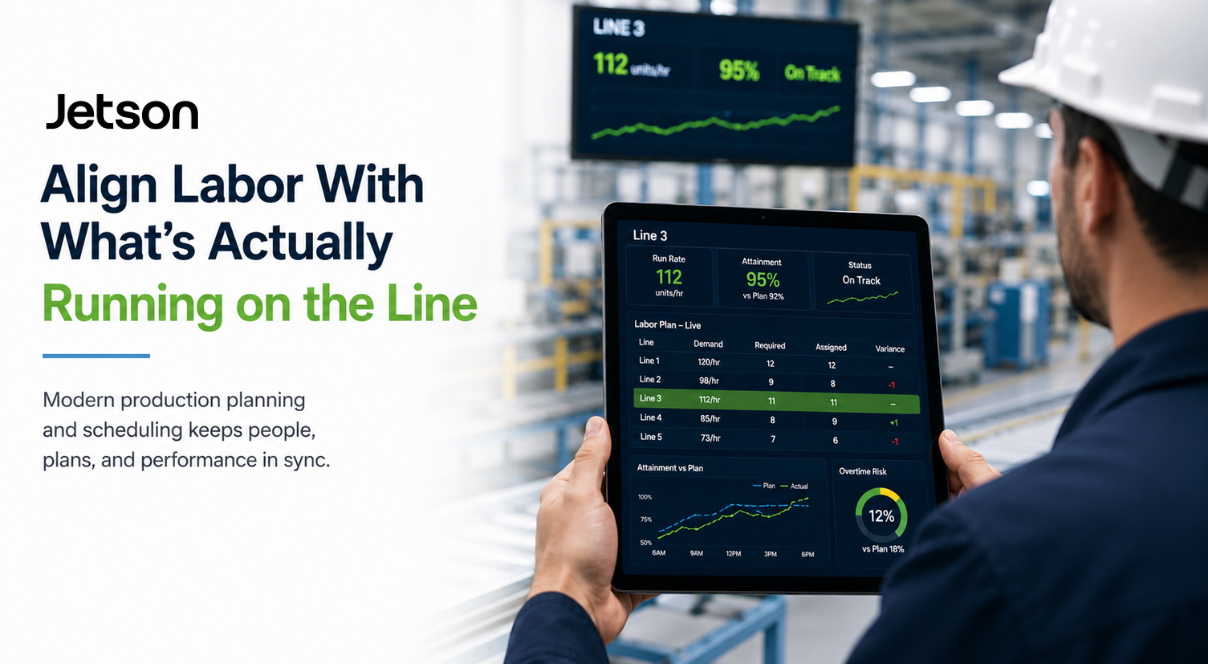
Modern production planning and scheduling closes that gap by tying labor directly to what is happening on the line right now. Instead of staffing against last quarter's assumptions, teams staff against live demand, real run rates, and the people who actually showed up. The result is fewer idle hours, fewer scrambles, and a much clearer line of sight into whether today is on track or quietly slipping. The sections below walk through how that connection works and why it changes the math on labor cost.
The Hidden Cost of Staffing Around Assumptions
When labor plans run on stale data, the waste rarely shows up in one obvious place. It hides in the margins. A line crewed for a run rate it has not hit in months carries one or two extra people every shift. Multiply that across lines, shifts, and weeks, and the overspend adds up to real money that never appears on a single report.
The opposite problem is just as expensive. Understaff a line because the standard says it needs four people when it really needs five, and you lose output you can never recover. The order ships late, or it ships short, and the cost shows up downstream as expedited freight or an unhappy customer. Neither failure announces itself. Both quietly drain the operation. And because the symptoms look like ordinary plant noise, a slow line one day, a missed order the next, the cause goes unexamined for months. By the time someone runs the numbers and notices a pattern, the operation has already paid for it many times over. The fix is rarely about adding people or cutting them in the abstract. It is the right people, in the right spots, matched to what the line actually demands that hour. That distinction is what separates a labor plan that controls cost from one that just looks tidy on paper.
The root issue is that crewing standards and run rates tend to be set once and revisited rarely. They live in an ERP, treated as fixed truth, even though the floor has changed around them. New equipment, a redesigned line, a more experienced crew, all of it moves the real numbers while the planning data stays put. Supervisors know the standards are off, so they pad schedules to be safe, which is its own form of overspend. Staffing around assumptions means paying for a buffer against uncertainty that better data would simply remove.
What Live Production Data Changes About Daily Crewing
The fix is not a better spreadsheet. It is a live connection between what the line is doing and how many people you put on it. Once labor requirements update continuously based on what is running, the daily crewing decision stops being a guess made the night before and becomes a response to current conditions. Demand swings, a line speeds up or slows down, an order gets pulled forward, and the labor plan moves with it. That kind of responsiveness is exactly what production planning and scheduling should account for, yet most legacy tools were never built to read the floor in real time. They treat the plan as the answer rather than a starting point.
Reading Run Rates as They Happen, Not as They Were Last Quarter
A run rate written into a standard six months ago is a historical average, not a prediction. Lines drift. A machine that ran at ninety units an hour when the standard was set might run at a hundred and ten today after a tooling change, or eighty after it started showing its age. Planning labor off the old number means you are always crewing for a plant that no longer exists.
Reading run rates as they happen flips that around. The actual throughput of each line feeds back into the plan, so the labor requirement reflects what the equipment is really doing this week. If a line is consistently beating its standard, the system can crew it leaner without risking the target. If it is falling short, the plan flags the gap early enough to do something about it. The standard stops being a guess frozen in an ERP and becomes a number that earns its place by matching reality. Supervisors get to trust the plan again, because the plan is built on what the floor actually produces, not what someone hoped it would produce a couple of quarters ago.
Turning a Production Schedule Into Real Labor Requirements
A production schedule tells you what needs to run and when. It does not, on its own, tell you how many people you need, which skills they need, or where they should stand. That translation step is where most planning falls apart, because it usually happens in someone's head or in a side spreadsheet that nobody updates.
Doing it well means taking the schedule and converting it into a precise labor requirement for every line and every hour. If line two runs a complex product for the first half of the shift and a simpler one after lunch, the headcount and skill mix should change at lunch, automatically. When the schedule shifts, the labor requirement shifts with it. A pulled-forward order, a canceled run, a shortened day for a holiday, each of these should ripple straight through to who you need on the floor and when. Handled this way, the plan reflects the work that actually has to get done rather than a rough average of a typical day. The whole point of production planning and scheduling is to make that link tight, so the people on the clock match the work in front of them.
Connecting Labor to the Systems Already Running Your Plant
None of this works if the labor plan lives on an island. Plants already run on a stack of systems. An ERP holds the production schedule, run rates, and crewing standards. An HRIS knows who works there. Time clocks know who punched in. Shop floor systems know what each line is doing right now. The labor plan only becomes useful when it sits in the middle of all of that, reading from each system and writing back to it. A modern operating platform connects to the tools you already depend on rather than asking your team to maintain yet another disconnected source of truth.
Pulling Crewing Standards and Run Rates Straight From the ERP
Your ERP is already the home for crewing standards and run rates. The problem is that those numbers usually stay locked in there, referenced when someone builds a plan and ignored the rest of the time. Pulling them directly into the labor plan keeps everyone working from the same baseline instead of from a copy that drifts out of date the moment it is exported.
The advantage is consistency. When the platform reads standards and rates straight from the ERP, there is no second version floating around in a manager's spreadsheet. A change made in the system of record flows through to the plan without anyone retyping it. That matters most in multi-site operations, where small differences in how each plant tracks its standards can make company-wide labor reporting nearly impossible to trust. A platform built to coordinate headcount against live production reads from the ERP as a starting point, then improves on it with what the floor demonstrates over time. The standard becomes a living reference rather than a static entry that someone set and forgot. You can see how that connection works on the Jetson operating platform built for plants and warehouses, which maps skills, schedules, and constraints to the work each shift requires.
Pushing Actuals Back So Your Data Stays Honest
Reading from the ERP is only half the loop. The other half is pushing actuals back. When the shift ends, the plant knows what really happened. How many units ran, how many people it took, how much overtime it burned, where the line lost time. If that information stays trapped in the heads of supervisors or buried in a daily report nobody reads, the planning data never improves.
Pushing actuals back into the system of record keeps the data honest. Next week's plan is built on this week's truth, not on a standard that was set a year ago and never questioned. Over time, the run rates and crewing standards converge on what the floor can actually deliver, because every shift feeds the next one. This is also where accountability lives. When actuals tie directly to work orders, an operations manager can see exactly where labor went and why, and that visibility tends to change behavior on its own. Overtime that used to disappear into a monthly total becomes a number tied to a specific decision on a specific line. Honest data does not just sharpen the plan. It changes how people manage against it.
Catching Coverage Gaps Before They Cost You the Shift
Most coverage problems are discovered too late. A supervisor walks the floor at the start of the shift, realizes line four is short a qualified operator, and spends the next hour pulling someone from another area and hoping they can run it. The gap was probably visible hours earlier, if anyone had been able to see it. Surfacing coverage gaps as they form, rather than after they have already cost you output, is one of the clearest wins of tying labor to live production. You can see coverage recommendations update in real time against who is on site and qualified, before the shift turns into a scramble.
Knowing Who Is On Site, Qualified, and Where They Belong
A name on a schedule is not the same as a qualified operator standing at the right station. People call out. They show up late. They are certified for one line but not the one that is short today. The schedule built yesterday assumed a perfect roster, and the floor almost never delivers one.
Closing that gap means matching real availability against real requirements, minute by minute. The system knows who actually punched in, what each person is qualified to run, and where the open seats are. Instead of a supervisor holding all of that in memory and reacting at the bell, the picture is already assembled. When someone is missing, the recommendation accounts for who else is on site and cleared to step in, so the move is a qualified swap rather than a warm body in the wrong spot. Start-of-shift chaos fades because the work of reconciling the roster against the plan already happened. Supervisors spend their attention on running the line well rather than on figuring out who is even there. The plan reflects the crew you have, not the crew you wished for when you built it.
What Happens When the Plan Breaks Mid-Shift
Plans break. A line goes down. A rush order jumps the queue. A second-shift no-show leaves a hole that has to be filled from the floor already running. The question is never whether the plan will hold all day, because it will not. The question is how fast the operation can adjust without losing the shift.
A static schedule offers no help here. It was right at 6 a.m. and useless by 9. A live plan, by contrast, recalculates the moment conditions change. When a line stops, the people staged for it can be redirected to where they add value instead of standing idle until someone notices. When an order moves up, the labor requirement updates so the right crew is in place before the run starts, not scrambling after it. The value is in the speed of the response. The faster a supervisor sees the new picture and the next best move, the less a disruption costs. Downtime still happens, call-outs still happen, but the damage gets contained because the plan keeps pace with the floor instead of falling a step behind it every time something goes sideways.
Measuring Output Against What the Line Can Actually Do
You cannot manage what you measure against the wrong yardstick. If the standard says a line should produce a thousand units with four people and it has never once done that, then every report comparing actual to plan is measuring against fiction. Performance looks bad even when the crew is doing everything right, because the target was never real. Measuring output against what the line can actually do, based on demonstrated performance rather than an aspirational standard, is what makes the numbers trustworthy enough to act on.
Schedule Attainment, Productivity, and Overtime in One Place
The three numbers that tell you whether a shift worked are usually scattered across three systems. Schedule attainment lives in one report, productivity in another, overtime in payroll. By the time someone stitches them together, the shift is long over and the moment to act has passed.
Bringing them into one view changes the timing. A supervisor can see, during the shift, whether the plan is being hit, how productive each line is running, and whether overtime is creeping in. That combination matters because the three are connected. Pushing for attainment by piling on overtime might hit today's target while wrecking the labor budget. Cutting crew to control overtime might save money today and miss the order. Seeing all three at once lets the person on the floor make the trade-off deliberately instead of discovering it after the fact. A live read on attainment, productivity, and overtime, paired with the ability to act on what you see, turns reporting from a postmortem into a tool you actually use while the shift is still running. The goal is to catch a problem at 10 a.m. when you can still fix it, not at 5 p.m. when all you can do is write it up.
Getting Operations, Finance, and HR Onto One View
Labor is one of the few things in a plant that three different departments all care about, and they rarely see it the same way. Operations cares about hitting the production target. Finance cares about the labor cost of hitting it. HR cares about who is scheduled, who is available, and whether the plan respects the rules. When each team works from its own data, they argue about whose numbers are right instead of solving the actual problem.
A shared view ends that argument. When operations, finance, and HR all read from the same live picture of labor against production, the conversation shifts from reconciling spreadsheets to making decisions. Finance can see overtime as it accrues rather than discovering it at month-end. HR can confirm that coverage recommendations respect qualifications and constraints. Operations can staff to the target knowing the cost side is visible to everyone. Once the data is shared and tied to work orders, there is nowhere for waste to hide. You can see how a range of manufacturers and distributors run their operations on a shared labor view and what it does to their numbers.
What Tighter Alignment Looks Like on a Real Plant Floor
The proof of any of this is in what changes once a plant turns it on. The pattern tends to look similar across operations. Planning that used to eat hours gets done in a fraction of the time. Labor spend comes down, not by cutting people, but by removing the idle hours and the padding that stale standards created. Skilled people end up on the work that needs their skill rather than parked on a line anyone could run. Visibility into staffing needs goes from a foggy guess to a clear number a manager can defend.
As one growing manufacturer scaled up, labor planning got harder to manage by hand, and centralizing the data plus automating the planning cut the manual effort while giving the team a far clearer read on what staffing each shift required. That is the shape of the win in most plants. Less time spent building plans, less money spent on labor that was not producing, and more confidence that the number on the schedule is the number the floor can hit. You can read what changed for Stella and Chewy's after centralizing labor data and see how the gains played out as they expanded manufacturing.
Putting Smarter Production Planning to Work With Jetson
The gap between the plan and the floor will never fully close, because plants run on people and people are unpredictable. What changes is how fast you can respond when reality drifts from the schedule. Jetson ties production planning and scheduling to live production, pulling run rates and crewing standards from your ERP, pushing actuals back, and surfacing coverage gaps before they cost you the shift. See how Jetson can help your team hit plan at the lowest cost, shift after shift.

.jpg)