
Five Ways to Improve Production Efficiency Without Adding Shifts or Equipment


.svg)
The Capacity Already Sitting Inside Your Current Operation
A packaging line runs two people short on a Tuesday because callouts hit at 6 a.m. and nobody rebalanced the crew before the shift started. The line still moves, just slower, and by the time a supervisor spots the gap, most of the morning is gone. That kind of quiet loss happens on plant floors every day, and it almost never shows up as its own line item. It surfaces later as missed targets, creeping overtime, and a schedule that never quite lines up with what the machines are actually doing.
When output falls short, most teams reach for one of two answers. Add a shift, or buy more equipment. Both work. Both also cost money you may not need to spend. The output you are missing is often already in the building, tied up in idle time, mismatched crewing, and the start-of-shift scramble that eats the first hour before anyone has run a single good part.
There are five practical ways to improve production efficiency that lean on the crews and lines already on the floor, with real-time data carrying the load instead of capital. None of them widen your footprint or add a payroll number. Each one targets a specific spot where output slips between the plan on paper and the shift that actually happens. Jetson is an AI-powered operations platform built for plants and warehouses, aimed at this exact problem, so the examples here reflect how live coordination tends to play out once a floor stops running on yesterday's assumptions.
Why Adding Shifts and Machines Is the Expensive Answer
Adding a shift or a machine solves a capacity problem, but most plants that miss targets do not have a capacity problem. They have a coordination problem. A new line adds fixed cost, ramp time, and maintenance before it produces a single unit, and a third shift brings a fresh payroll load plus the overhead of hiring and training in a tight labor market. Both bets assume the existing operation is already running at its ceiling. It usually is not.
Look at where a typical shift actually goes. Time disappears at changeovers that wait on the right operator, at stations staffed above what the current run rate needs, and at the handoff between shifts where nobody knows who is qualified for what. None of that is fixed by more square footage. It is fixed by matching labor to demand hour by hour, which is far cheaper than concrete and steel.
There is also a timing argument. A capital project can take quarters to approve and longer to pay back. Retuning how you deploy the crew you already employ can show results inside a few weeks. When the goal is more good units per shift without a bigger budget, the smarter first move is to wring the waste out of the current operation before signing off on anything that shows up as depreciation.
Match Labor to What the Line Is Actually Running
The fastest gain comes from staffing to what the line is running right now, not to a roster set last week. A static schedule assigns the same headcount to a station whether it is running a long stable job or a short finicky one, which leaves some spots overstaffed and others short. When the production schedule shifts, as it always does, the labor plan stays frozen and the mismatch grows through the shift.
Live coordination flips that. When labor requirements update as jobs change on the floor, a supervisor can move two people off a line that is coasting and onto the changeover that is about to bottleneck. Idle time shrinks because nobody is standing at a station that does not need them, and coverage gaps close because the plan reflects the real run, not a guess made before anyone clocked in.
This is the core of what an AI-powered operations platform tied to live production does. It translates the production schedule into labor requirements that keep updating based on what is actually running, so the crew you have is always pointed at the work that needs hands. The equipment never changed and the headcount never grew. The only thing that moved was how precisely the people were aimed, and that alone can recover output a plant had written off as normal loss.
Turn the Production Schedule Into a Live Staffing Plan
The mechanism behind this is translating the production schedule into a labor plan the floor can act on, then keeping that plan current as the day moves. Instead of a manager mentally converting a run schedule into crew assignments and hoping the math holds, the requirement for each station is generated from the job that is queued and adjusted when the queue changes.
Picture a shift where a high-speed SKU finishes two hours early and a slower, more manual job moves up. A frozen schedule keeps the crew where they were and the new job runs understaffed. A live plan flags the change, shows which qualified operators are free, and recommends the move before the slow job starts choking. That is the difference between finding out at end of shift that you missed and catching it while the shift is still recoverable. The plan becomes a working tool rather than a document filed at 6 a.m. and ignored by 9.
Close Coverage Gaps Before the Shift Starts
Coverage gaps close when you know who is on-site and qualified before the whistle, not after. The most expensive fifteen minutes in a plant is the start of a shift, when supervisors are chasing down who showed up, who is trained on which line, and who needs to cover the two people who called out. Every minute spent sorting that out is a minute the line is not producing at rate.
The scramble happens because availability and qualification data usually live in different places. Attendance is in one system, skills matrices in a spreadsheet, and the actual roster in the supervisor's head. By the time all three get reconciled, the shift is underway and the gaps have already cost you. Automated coverage recommendations pull who is present and what they are certified to run into one view, so the first assignment of the day is right the first time.
Getting the right qualified people to the right stations at the start also protects quality, not just speed. An operator placed on a line they know runs it cleaner, with fewer stoppages and less scrap, than someone dropped in to plug a hole. Close the coverage gap before the shift starts and you remove a daily source of lost output that most plants have simply learned to tolerate.
Put Qualified People Where the Work Is
Qualification matching means putting the person who is certified and practiced on a line onto that line, rather than filling a slot with whoever is closest. A body in a chair is not the same as coverage. A station staffed by someone still learning it runs slower and generates more rework, which quietly drags down the numbers even when the headcount looks complete on paper.
When the system knows each worker's certifications and recent experience, it can recommend placements that respect both. That keeps your strongest operators on the demanding lines and routes cross-trained staff to fill in where they are genuinely capable. Over a full shift, the compounding effect of every station being run by someone competent is real throughput, earned without adding a single person to the payroll. The crew is the same size. It is just aimed with more care.
Plan Off Demonstrated Performance, Not Outdated Standards
Plan the next shift off what your lines have actually demonstrated, not off run rates and crewing standards someone set years ago. Many plants still schedule against numbers baked into the ERP long before the current product mix, tooling, or crew existed. When the standard says a line does 400 units an hour and it reliably does 340, every plan built on that number is wrong before the shift starts, and the crew gets blamed for a gap the math created.
Working from demonstrated performance fixes the baseline. When real run rates flow back from the floor and update the planning assumptions, the schedule finally reflects reality. You staff the line that genuinely needs more hands and stop overstaffing the one that has quietly gotten faster. Jetson keeps this loop closed by syncing run rates and crewing standards from your ERP and pushing actuals back, so the plan and the floor stay in agreement instead of drifting apart.
This is one of the clearest ways to improve production efficiency without touching the equipment, because it removes the guesswork from every downstream decision. Better baselines mean better staffing, tighter targets, and forecasts a plant manager can actually stand behind. The line did not get faster overnight. You just stopped planning as if it were a machine you last measured three product generations ago.
Make Overtime a Decision Instead of a Surprise
Overtime should be a call you make on purpose, in the moment, not a number you discover when payroll runs on Friday. On most floors, overtime accumulates invisibly. A line runs behind, a supervisor keeps a few people late to catch up, another does the same on the next shift, and by week's end the plant has spent thousands in premium pay that nobody decided to spend. The cost is real and the visibility is near zero until it is too late to change anything.
Real-time visibility into hours changes the posture from reactive to deliberate. When a manager can see, mid-shift, that a line is trending toward overtime and why, the choice becomes explicit. Sometimes the extra hours are worth it to hit a customer commitment. Sometimes rebalancing the existing crew closes the gap without a dime of premium pay. Either way, it is a decision made with eyes open rather than a bill that lands after the fact.
Manufacturers and warehouses already running on this kind of coordination tend to describe the same shift in mindset. Overtime stops being a monthly surprise and becomes a lever they control. Pulling it down does not mean pushing people harder. It means matching hours to demand closely enough that the premium ones are the exception, spent when they earn their keep and not before.
Give Floor Leaders Tools to Correct the Shift in Real Time
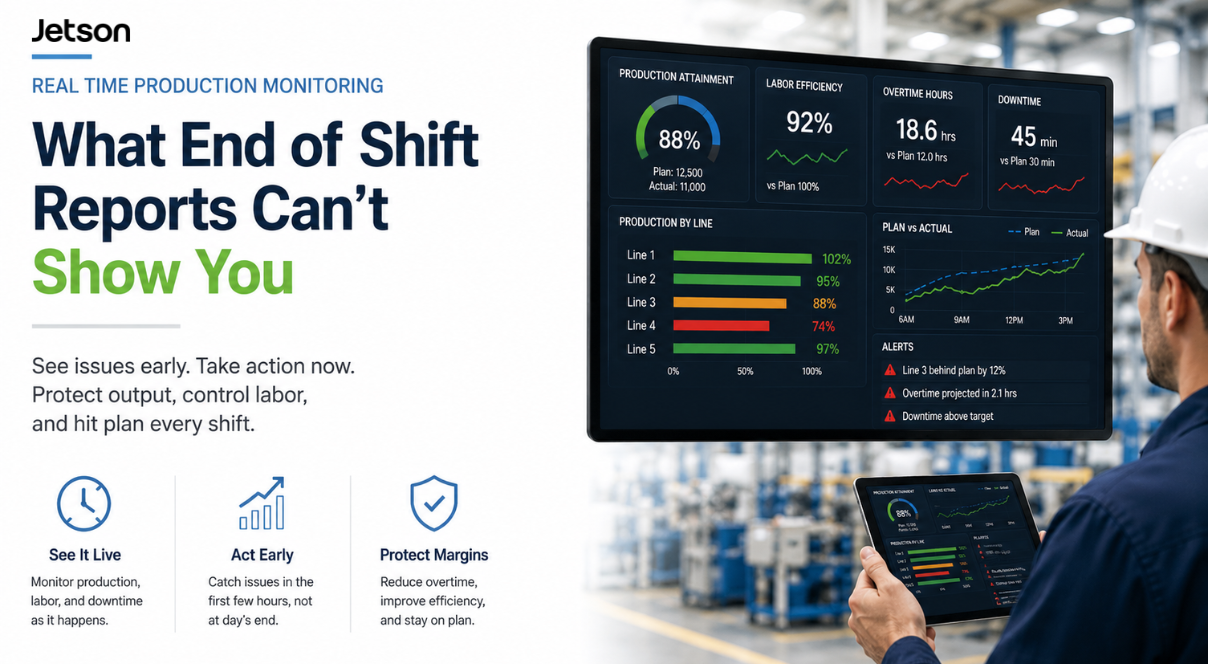
Give supervisors the ability to see how the shift is tracking and fix it while it is still running, and you turn a report into a result. Most plant data arrives too late to matter. A dashboard that tells you yesterday missed by 8 percent is a history lesson. What a floor leader needs is a live read on schedule attainment and productivity during the shift, paired with the means to act on it before the shift ends.
That combination is where a lot of recoverable output hides. When a line starts falling behind at hour two, an early signal lets a supervisor rebalance the crew, clear a bottleneck, or reprioritize the queue while there is still time to make the number. Wait until the after-action review and all you can do is explain the miss. The tools to take corrective action have to sit where the work is, in the same place the supervisor is already looking, or they will not get used under the pressure of a running line.
This real-time correction is quietly one of the strongest ways to improve production efficiency, because it converts data from a rear-view record into a steering wheel. The plant stops learning about problems in the morning meeting and starts solving them on the floor. Nothing about the equipment or the crew size changed. The feedback loop simply got short enough to act on.
Catch the Drift While You Can Still Recover
Catching drift early is the whole game, because a small deviation at hour two is cheap to correct and the same deviation at hour seven is a lost shift. Production rarely falls off a cliff. It leaks slowly, a few minutes here, a slow changeover there, a station running light without anyone flagging it, until the accumulated gap is too big to close.
An early warning turns those small leaks into quick fixes. If the system surfaces that a line is running 6 percent under plan by mid-morning, a supervisor can investigate and adjust while the fix still fits inside the shift. That might mean moving a floater, resequencing a job, or clearing a material shortage before it stalls the line. The point is to compress the time between a problem appearing and someone doing something about it. Shorten that gap and a whole category of misses simply stops happening, not because the crew works harder but because they stop finding out too late.
Connect the Systems You Already Depend On
Real-time coordination only works if it plugs into the systems your plant already runs, and Jetson is built to do exactly that. Live labor decisions depend on data that lives in your HR platform, your ERP, and your shop floor systems. If that information stays siloed, no amount of scheduling logic can help, because the plan will always be working from a partial picture.
The integration reach here is broad and specific. On the shop floor side it connects with tools like RedZone and QAD. On the ERP side it works with NetSuite, SAP, Microsoft Dynamics 365, and Plex. For people data it ties into HRIS platforms including Paylocity, ADP, UKG, and Paycom, and it feeds reporting tools such as Power BI and Tableau. It also connects to data warehouses like Databricks and Snowflake, so historical labor and production numbers stay queryable next to everything else your analysts already pull. The fewer places a fact has to be re-entered by hand, the fewer chances there are for the plan to run on stale or wrong data. That range matters because it means the labor plan draws on the same source of truth the rest of the operation already trusts, rather than asking teams to maintain yet another disconnected system.
Security sits alongside that connectivity. Jetson is SOC 2 Type II certified, with independent audits, regular penetration testing, and security reviews behind it. For a plant weighing whether to route live workforce and production data through a new platform, that certification is the baseline that makes the rest of the conversation possible. Connected data and audited security are what let real-time coordination actually run rather than stall at the IT review.
What the Payoff Looks Like on a Real Plant Floor
The payoff is measurable, and Stella and Chewy's put real numbers on it. As the pet food manufacturer expanded its operations, labor planning got harder to scale, so the team centralized its labor data and automated the planning that used to happen by hand. The results speak to every lever covered so far.
The Stella and Chewy's results include a 10 percent decrease in budgeted labor spend and a 9 percent increase in skilled labor utilization, both earned without adding shifts or lines. On the visibility side, the team gained ten times greater visibility into its labor needs and cut the time spent planning by 80 percent, which handed hours back to supervisors who had been buried in spreadsheets. Those two categories reinforce each other. Better visibility drives better staffing, and better staffing shows up directly in the spend.
What stands out is that none of it came from more capital. It came from planning off real data, deploying qualified people more precisely, and giving the team a live view instead of a backward-looking one. The same moves are available to any plant willing to trade guesswork for coordination, and the gains tend to compound as the operation scales rather than fading once the novelty wears off.
Rolling It Out Without Months of Disruption
Rolling this out takes weeks, not the quarters a capital project or an ERP overhaul demands. Jetson gets plants live in about four weeks through a white glove implementation, with a dedicated team that maps skills, capabilities, schedules, and overtime constraints to the work each shift needs to get done, then stays on as the operation scales. That timeline matters because it changes the risk math. A four-week rollout can prove itself before the next quarter closes.
Skepticism about new software on a plant floor is fair. Teams have seen tools that promised the world and added steps. The difference with a short, guided rollout is that supervisors feel the value inside the first month, on real shifts, rather than waiting on a payback that always seems to slip. Support that answers in minutes across every time zone keeps the momentum going once the initial team steps back.
Fast implementation is also what makes the case for coordination over capital hold up. If the alternative to a new shift or a new line is a project that takes a year to land, the math gets murky. When the alternative pays back inside a month or two, choosing to improve production efficiency with the crew and lines you already have becomes the obvious first move, not the fallback.
Turning Existing Lines Into Your Next Gain
The next gain on your floor is probably not behind a purchase order. It is in the idle time, the start-of-shift scramble, and the stale standards you have learned to work around. Match labor to live demand, plan off real performance, and give your team a view they can act on mid-shift, and the output is there. To see how it holds up against your own numbers, request a walkthrough with Jetson and put it against a real shift.
.jpg)